




Have Problems?

Call 800-729-1570 and ask to speak with a Fluids Technical Specialist.

Or fill out this form and send it with a sample of at least 8-16 ounces (or 250 ml) to:

Fluids Technical Specialist
Active Cutting Fluids
2628 N. Mascher Street
Philadelphia, PA  19133

Want to know more about which fluid properties are optimum for your application?
Call 800-729-1570 to discuss your needs with our Fluids Technical Specialist.


This area of our website is designed to provide information about industrial fluids for visitors across a broad range of backgrounds. Our primary focus as our name implies is fluids used in metalworking including: CNC machining, die-cutting, drilling, grinding, milling, reaming, superfinishing, tapping, threading and turning. We are also an online merchant of industrial fluids for these metalworking uses: drawing, stamping, electronic discharge machining [EDM], mass finishing, cleaning and rust prevention. 

We plan to regularly add resources, so check back for more technical and useful information.

The Workhorse: Water

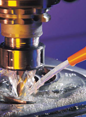
As many industrial metalworking people know, metalcutting fluids are added to water. Water has a very high specific heat capacity and it is inexpensive. So, water does most of the work. However, various manufacturing or cooling operations also require the following

  • surfactants that clean and suspend dirt and oils
  • control over the lubricity of the fluid
  • corrosion resistance
  • biocide chemistry to prevent bacteria, mold and mildew
  • reduce foaming when water flows under high pressure
  • chemistry to prevent the breakdown of seals

This is why typically a metalworking fluids gets added to water [unless the application requires a straight oil (all oil)]. The fluid that is added to the water – i.e. the additive – provides chemistry that delivers the added benefits that water does not have on its own. 

A water-soluble oil is an emulsion; semi-synthetic and synthetic fluids work a little differently. A primary consideration with semi-synthetic and synthetic fluids is that the water evaporates more quickly than the additive, so the additive-to-water concentration needs to be monitored. This is typically done with a refractometer. Please note that when the additive concentration is too high or the fluid as a whole is too dirty, then workers easily get skin problems (dermatitis).


Six Steps for Cutting Fluids Success

Format: PDF
Size: 103 KB
DOWNLOAD NOW
Description:

Describes 6 steps for managing your metalworking fluid to deliver consistent solid performance.

Share:

Understanding the Basics of Metalworking Fluids

Format: PDF Size: 104 KB DOWNLOAD NOW
Description:

Taking care of your metalworking fluid can significantly reduce tool cost, reduce fluid cost, and make the work environment more safe for workers. This document covers the basics of industrial metalworking fluids and their proper maintenance.

Share:
FEATURED MANUFACTURERS
Loading...